
When I took over email and lifecycle marketing at a $120M health and wellness brand, I asked what I assume every new owner of a channel asks: what's our target?
Turns out, there wasn't one.
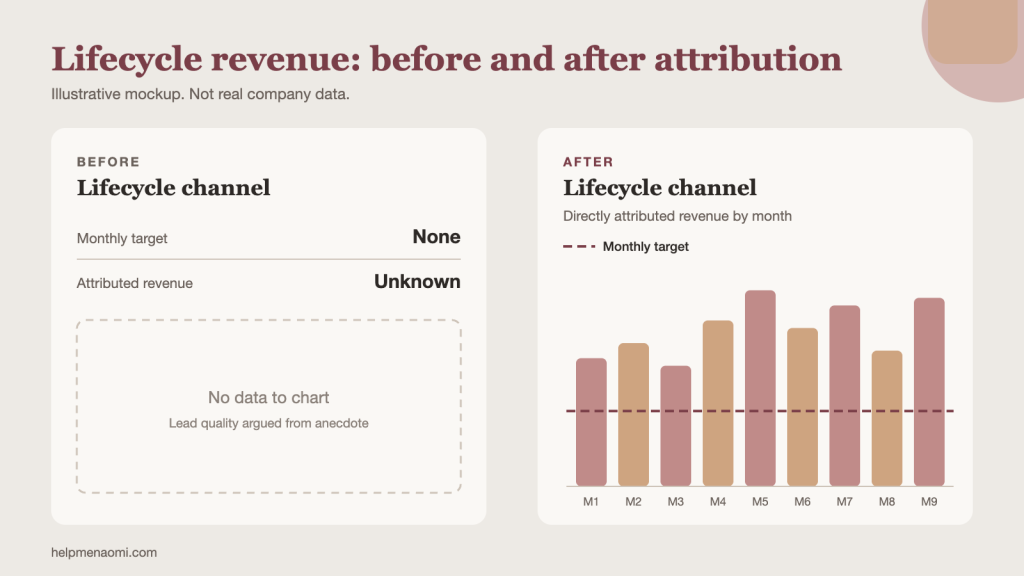
Nobody had ever missed a number because nobody had ever been given one to aim for. Email and SMS went out every day. Customers bought things. But no one could say how much of that revenue lifecycle produced, so no one could set a goal for it, give it resources, or argue for it in a budget meeting.
There was no attribution to email or lifecycle at all.
It's a strange place to be, and I suspect more marketing teams are in it than will admit it. They're being told the channel is failing, but really, it's invisible.
The Short Version
- If your lifecycle channel has never been measured, you don't have a performance problem yet. You have a measurement problem.
- You don't need a perfect model to fix it. I started with basic last-touch attribution: did this email drive a purchase?
- That simple model was enough to prove the channel, and proving it is what made the channel's first revenue target possible.
Invisible Is Worse Than Bad
One thing I've always told everyone: document everything.
I learned the hard way that having no numbers is way worse than having bad numbers.
A bad number gives you something to work with. You can diagnose it, test against it, and show progress. But an invisible channel gets none of that. In practice it gets three things:
- It gets argued about from anecdote. Everyone has a story about what's working, and nobody can check it.
- It gets resourced by vibes. Headcount and tooling go to whatever channel has the best slide, not the one doing the most work.
- It can't be improved on purpose. You can run tests, but you're improving a number nobody is watching.
So I didn't start by fixing the program. I started by making it measurable.
Why I Started with Last Touch
Last-touch attribution kind of has a bad reputation, and for a mature program it certainly earns some of it. It gives all the credit for a purchase to the final message before it and ignores everything that came earlier.
And as you know, it takes an average of 8 touches just to earn a first conversation with a new prospect, and a purchase can take even more. How can you tell that those initial touches are as effective as they could be if you're not measuring them?
I know! And if I could have, I would have jumped right into multi-touch attribution. But the truth was, the first thing I needed to do was to answer one question nobody could answer yet: is this channel producing revenue at all?
For that question, simple was the point:
- It's easy to explain. “This email went out, and this person bought” doesn't need a slide on methodology.
- It's quick to stand up. You can get to a first number without waiting on a big data project.
- It's hard to argue with. Every dollar it counts traces back to a specific email.
What the First Model Had to Answer
The whole model came down to one question: did this email drive a purchase?
The most useful thing you can do at this stage is write that rule down before you show anyone a number. What counts as “drove”? How long after the email can the purchase happen and still count? If the rule lives only in your head, every number you present becomes a debate about the rule instead of a conversation about the channel.
So for this, I started by following my typical cadence for checking other email metrics, which included a check for open and click rates at 24 hours and again at 48 hours for sends and broadcasts, and once a week for evergreen campaigns and automated lifecycle emails.
This also meant that pulling the numbers and associating them with the emails was going to be the easy part: UTM parameters embedded into every link and analyzed through Shopify's own explorations.
It wasn't fully automated and pretty yet, but it worked and it got me the answers I needed.
So the rule I wrote down was simple: if someone clicked a UTM-tagged link in an email, and that email was the last tracked touch before they placed a Shopify order, the email got the credit.
Next, Bring the Target Into Existence
I knew that once email and lifecycle each had a number they could point to, the company could do something it had never done before: set a target for these channels.
Unfortunately, because they had never done any tracking and had fairly convinced themselves that email didn't work to bring in revenue, I didn't really have much to go off of. And it was a bit of a battle because trying to prove attribution for the email led the Shopify team to believe that their numbers were going to go down.
And, to make things even harder, there was no real tracking information on the site at all. I had click-rate information from Salesforce Marketing Cloud, but otherwise no way of knowing how much traffic email even drove to the site at all. And, because I love a good challenge, all the emails in the past led to the shop's home page rather than the products' pages, so even trying to reverse-engineer old landing page views from old click rates was nearly impossible due to the amount of friction the customers ran into.
And on top of everything else, we were getting ready to launch a brand new product that was, as yet, unproven, so while we held high hopes, we didn't know how much revenue we could forecast for this line.
Leadership set the goal for this new product launch to be $100,000 for the first week, so I decided to try to use that launch to help me set up a benchmark. I knew a healthy share of the revenue would put email at roughly 25% and that lifecycle could normally account for roughly 60% of revenue, so that's what I aimed for.
Unfortunately, I did have to wait before I had my answers. I didn't have access to any of the revenue or sales numbers, and because I was still new to this company I wasn't on any of the normal distro lists. And everyone was especially nervous about this launch because we found out after going live that there was a problem with our ad accounts and we weren't able to launch ads with it. Which meant everything was running on email, website, and organic social media (another channel no one was tracking revenue attribution for).
A week later, I got the numbers: the launch had come in at 263% of target after the first week, bringing in $263,000 in revenue. $84,000 of that was attributed to email blasts: roughly 32%. And just over double that, roughly $170,000, was attributed to the upsell emails added into the lifecycle.
We finally had a number to aim for, a way to track it, and proof it would work.
The following week, as post-launch numbers evened out and I had more data to work with, I set the monthly revenue target for email to $50,000 and lifecycle to $100,000, which was about 20% and 40% (respectively) of what I was told the average monthly revenue for Shopify was at the time.
Looking back, emails ran consistently between $80,000 and $130,000 per month, and lifecycle ran consistently between $115,000 and $225,000 per month for the rest of my time there. Although, the attribution model was going to change, for now I had what I needed.
What I'd Do Differently
I already hinted: the attribution model was going to be changing. That's because when I first set this up, the overall scope was defined as DTC: emails and Shopify. So it seemed really straightforward and last-touch attribution was really all we were going to need. What I didn't know until it was too late was that we were going to be moving sales teams over to HubSpot and, with them, various pipelines and offers that were not available through Shopify. That meant a variable sales cycle, different compliance requirements, all new automations…all kinds of things.
So, one thing I would do differently if I were to do it again would be to sit down with everyone across the teams and find out what the final look was going to be. I built the last-touch attribution model because it answered a question, not because that's what we needed. And it turned out that what we really needed was going to be a lot bigger and more complex and if I'd known that at the beginning I would have planned things differently.
If Your Channel Is Invisible Too
The quick test: ask your team what lifecycle produced last month. Or even just what email produced. If the answer is a shrug, a vanity metric, or “it's hard to say,” then it's pretty safe to say you don't have a performance problem…yet. Because it's impossible to have a performance problem if you still have a measurement problem, and that's the one to solve first.
And you don't need a lot to start: start with one question and one rule. You can build something more complete later.
Questions People Ask Me About Lifecycle Attribution
What Is Last-Touch Attribution in Email Marketing?
Last-touch attribution gives full credit for a purchase to the last marketing message a customer engaged with before buying. It's simple and easy to explain, and it ignores the touches that came before.
Is Last-Touch Attribution Good Enough?
For proving that a channel produces revenue, usually yes. Its limits show up later, when you want to understand repeat purchases or which messages helped earlier in the journey. Start simple, and add complexity once the channel has earned the attention.
Where Do You Start If Your Lifecycle Channel Has Never Been Measured?
Pick one question, such as “did this email drive a purchase?”, write down the rule for what counts, and get a first number. Then set a target against it.
I write about marketing operations, lifecycle, and the systems behind them in The Double Opt-In, my newsletter on LinkedIn.


